A Dissertation Upon Roast Pig
by Charles Lamb (1755 - 1834)
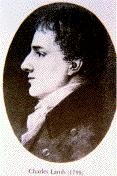
(Originally published in London Magazine, September 1822,
it also appeared in Essays of Elia, 1823)
MANKIND, says a Chinese manuscript,
which my friend M. was obliging enough to read and explain to
me, for the first seventy thousand ages ate their meat raw, clawing
or biting it from the living animal, just as they do in Abyssinia
to this day. This period is not obscurely hinted at by their great
Confucius in the second chapter of his Mundane Mutations, where
he designates a kind of golden age by the term Cho-fang, literally
the Cooks' holiday. The manuscript goes on to say, that the art
of roasting, or rather broiling (which I take to be the elder
brother) was accidentally discovered in the manner following.
The swine-herd, Ho-ti, having gone out into the woods one morning,
as his manner was, to collect mast for his hogs, left his cottage
in the care of his eldest son Bo-bo, a great lubberly boy, who
being fond of playing with fire, as younkers of his age commonly
are, let some sparks escape into a bundle of straw, which kindling
quickly, spread the conflagration over every part of their poor
mansion, till it was reduced to ashes. Together with the cottage
(a sorry antediluvian make-shift of a building, you may think
it), what was of much more importance, a fine litter of new-farrowed
pigs, no less than nine in number, perished. China pigs have been
esteemed a luxury all over the east from the remotest periods
that we read of. Bo-bo was in the utmost consternation, as you
may think, not so much for the sake of the tenement, which his
father and he could easily build up again with a few dry branches,
and the labour of an hour or two, at any time, as for the loss
of the pigs. While he was thinking what he should say to his father,
and wringing his hands over the smoking remnants of one of those
untimely sufferers, an odour assailed his nostrils, unlike any
scent which he had before experienced. What could it proceed from? --
not from the burnt cottage -- he had smelt that smell before --
indeed this was by no means the first accident of the kind
which had occurred through the negligence of this unlucky young
fire-brand. Much less did it resemble that of any known herb,
weed, or flower. A premonitory moistening at the same time overflowed
his nether lip. He knew not what to think. He next stooped down
to feel the pig, if there were any signs of life in it. He burnt
his fingers, and to cool them he applied them in his booby fashion
to his mouth. Some of the crums of the scorched skin had come
away with his fingers, and for the first time in his life (in
the world's life indeed, for before him no man had known it) he
tasted -- crackling! Again he felt and fumbled at the pig. It
did not burn him so much now, still he licked his fingers from
a sort of habit. The truth at length broke into his slow understanding,
that it was the pig that smelt so, and the pig that tasted so
delicious; and, surrendering himself up to the new-born pleasure,
he fell to tearing up whole handfuls of the scorched skin with
the flesh next it, and was cramming it down his throat in his
beastly fashion, when his sire entered amid the smoking rafters,
armed with retributory cudgel, and finding how affairs stood,
began to rain blows upon the young rogue's shoulders, as thick
as hail-stones, which Bo-bo heeded not any more than if they had
been flies. The tickling pleasure, which he experienced in his
lower regions, had rendered him quite callous to any inconveniences
he might feel in those remote quarters. His father might lay on
but he could not beat him from his pig, till he had fairly made
an end of it, when, becoming a little more sensible of his situation,
something like the following dialogue ensued.
"You graceless whelp, what have you got there devouring?
Is it not enough that you have burnt me down three houses with your dog's tricks,
and be hanged to you, but you must be eating fire, and I know not
what -- what have you got there, I say ?"
"O father, the pig, the pig, do come and taste how nice the burnt pig eats."
The ears of Ho-ti tingled with horror.
He cursed his son, and he cursed himself that ever
he should beget a son that should eat burnt pig.
Bo-bo, whose scent was wonderfully sharpened since morning,
soon raked out another pig,
and fairly rending it asunder, thrust the lesser half by main
force into the fists of Ho-ti, still shouting out "Eat, eat,
eat the burnt pig, father, only taste -- O Lord," -- with
such-like barbarous ejaculations, cramming all the while as if
he would choke.
Ho-ti trembled every joint while he grasped the abominable thing,
wavering whether he should not put his son to death for an unnatural young monster,
when the crackling scorching his fingers, as it had done his son's,
and applying the same remedy to them, he in his turn tasted some
of its flavour, which, make what sour mouths he would for a pretence,
proved not altogether displeasing to him. In conclusion (for the
manuscript here is a little tedious) both father and son fairly
sat down to the mess, and never left off till they had despatched
all that remained of the litter.
Bo-bo was strictly enjoined not to let the secret escape,
for the neighbours would certainly have stoned them for a couple of abominable wretches,
who could think of improving upon the good meat which God had sent them.
Nevertheless, strange stories got about.
It was observed that Ho-ti's cottage was burnt down now more frequently than ever.
Nothing but fires from this time forward.
Some would break out in broad day, others in the night-time.
As often as the sow farrowed, so sure was the house of Ho-ti to be in a blaze;
and Ho-ti himself, which was the more remarkable, instead of chastising his son,
seemed to grow more indulgent to him than ever.
At length they were watched, the terrible mystery discovered,
and father and son summoned to take their trial at Pekin,
then an inconsiderable assize town.
Evidence was given, the obnoxious food itself produced
in court, and verdict about to be pronounced, when the foreman
of the jury begged that some of the burnt pig, of which the culprits
stood accused, might be handed into the box.
He handled it, and they all handled it, and burning their fingers,
as Bo-bo and his father had done before them, and nature prompting to each of them
the same remedy, against the face of all the facts, and the clearest
charge which judge had ever given, -- to the surprise of the whole
court, towns- folk, strangers, reporters, and all present -- without
leaving the box, or any manner of consultation whatever, they
brought in a simultaneous verdict of Not Guilty.
The judge, who was a shrewd fellow, winked at the manifest iniquity of the decision:
and, when the court was dismissed, went privily, and bought up
all the pigs that could be had for love or money.
In a few days his Lordship's town house was observed to be on fire.
The thing took wing, and now there was nothing to be seen but fires in every direction.
Fuel and pigs grew enormously dear all over the district.
The insurance offices one and all shut up shop.
People built slighter and slighter every day, until it was feared that the
very science of architecture would in no long time be lost to the world.
Thus this custom of firing houses continued, till in process of time,
says my manuscript, a sage arose, like our Locke, who made a discovery,
that the flesh of swine, or indeed of any other animal, might
be cooked (burnt, as they called it) without the necessity of
consuming a whole house to dress it.
Then first began the rude form of a gridiron.
Roasting by the string, or spit, came in a century or two later, I forget in whose dynasty.
By such slow degrees, concludes the manuscript, do the most useful,
and seemingly the most obvious arts, make their way among man-kind.
Without placing too implicit faith in the account above given, it must be agreed,
that if a worthy pretext for so dangerous an experiment as setting houses on fire
(especially in these days) could be assigned in favour of any culinary object,
that pretext and excuse might be found in ROAST PIG.
Of all the delicacies in the whole mundus edibilis,
I will maintain it to be the most delicate -- princeps obsoniorum.
I speak not of your grown porkers -- things between pig and pork --
those hobbydehoys -- but a young and tender suckling -- under a moon old --
guiltless as yet of the sty -- with no original speck of the amor immunditiae,
the hereditary failing of the first parent, yet manifest --
his voice as yet not broken, but something between a childish treble,
and a grumble -- the mild forerunner, or praeludium, of a grunt.
He must be roasted.
I am not ignorant that our ancestors ate them seethed, or boiled --
but what a sacrifice of the exterior tegument!
There is no flavour comparable, I will contend, to that of the crisp,
tawny, well-watched, not over-roasted, crackling, as it is well called --
the very teeth are invited to their share of the pleasure at this banquet
in overcoming the coy, brittle resistance -- with the adhesive oleaginous --
O call it not fat -- but an indefinable sweetness growing up to it --
the tender blossoming of fat -- fat cropped in the bud -- taken in the shoot --
in the first innocence -- the cream and quintessence of the child-pig's yet pure food --
the lean, no lean, but a kind of animal manna -- or, rather, fat and lean
(if it must be so) so blended and running into each other,
that both together make but one ambrosian result, or common substance.
Behold him, while he is doing -- it seemeth rather a refreshing warmth,
than a scorching heat, that he is so passive to.
How equably he twirleth round the string! -- Now he is just done.
To see the extreme sensibility of that tender age,
he hath wept out his pretty eyes -- radiant jellies -- shooting stars -
See him in the dish, his second cradle, how meek he lieth wouldst
thou have had this innocent grow up to the grossness and indocility
which too often accompany maturer swinehood?
Ten to one he would have proved a glutton, a sloven, an obstinate,
disagreeable animal -- wallowing in all manner of filthy conversation --
from these sins he is happily snatched away -
Ere sin could blight, or sorrow fade,
Death came with timely care -
his memory is odoriferous -- no clown curseth, while his stomach half rejecteth,
the rank bacon -- no coalheaver bolteth him in reeking sausages --
he hath a fair sepulchre in the grateful stomach of the judicious epicure --
and for such a tomb might be content to die.
He is the best of Sapors.
Pine-apple is great. She is indeed almost too transcendent --
a delight, if not sinful, yet so like to sinning, that really a
tender-conscienced person would do well to pause -- too ravishing for
mortal taste, she woundeth and excoriateth the lips that approach her --
like lovers kisses, she biteth she is a pleasure bordering
on pain from the fierceness and insanity of her relish --
but she stoppeth at the palate -- she meddleth not with the appetite --
and the coarsest hunger might barter her consistently for a mutton chop.
Pig -- let me speak his praise -- Is no less provocative of the appetite,
than he is satisfactory to the criticalness of the palate.
The strong man may batten on him, and the weakling refuseth not his mild juices.
Unlike to mankind's
mixed characters, a bundle of virtues and vices, inexplicably
intertwisted, and not to be unravelled without hazard, he is good
throughout. No part of him is better or worse than another. He
helpeth, as far as his little means extend, all around. He is
the least envious of banquets. He is all neighbours' fare.
I am one of those, who freely and ungrudgingly impart a share of the good things
of this life which fall to their lot (few as mine are in this kind) to a friend.
I protest I take as great an interest in my friend's pleasures, his relishes,
and proper satisfactions, as in mine own.
"Presents," I often say, "endear Absents."
Hares, pheasants, partridges, snipes, barn-door chicken (those
"tame villatic fowl"), capons, plovers, brawn, barrels
of oysters, I dispense as freely as I receive them.
I love to taste them, as it were, upon the tongue of my friend.
But a stop must be put somewhere.
One would not, like Lear," give every thing."
I make my stand upon pig.
Methinks it is an ingratitude to the Giver of all good flavours,
to extra-domiciliate, or send out of the house, slightingly,
(under pretext of friendship, or I know not what) a blessing so particularly adapted,
predestined, I may say, to my individual palate -- It argues an insensibility.
I remember a touch of conscience in this kind at school.
My good old aunt, who never parted from me at the end of a holiday
without stuffing a sweet-meat, or some nice thing, into my pocket,
had dismissed me one evening with a smoking plum-cake, fresh from the oven.
In my way to school (it was over London bridge) a grey-headed old beggar saluted me
(I have no doubt at this time of day that he was a counterfeit).
I had no pence to console him with, and in the vanity of self-denial,
and the very coxcombry of charity, school-boy-like, I made him
a present of -- the whole cake! I walked on a little, buoyed up,
as one is on such occasions, with a sweet soothing of self-satisfaction;
but before I had got to the end of the bridge, my better feelings
returned, and I burst into tears, thinking how ungrateful I had
been to my good aunt, to go and give her good gift away to a stranger,
that I had never seen before, and who might be a bad man for aught
I knew; and then I thought of the pleasure my aunt would be taking
in thinking that I -- I myself, and not another -- would eat her
nice cake -- and what should I say to her the next time I saw
her -- how naughty I was to part with her pretty present -- and
the odour of that spicy cake came back upon my recollection, and
the pleasure and the curiosity I had taken in seeing her make
it, and her joy when she sent it to the oven, and how disappointed
she would feel that I had never had a bit of it in my mouth at
last -- and I blamed my impertinent spirit of aims-giving, and
out-of-place hypocrisy of goodness, and above all I wished never
to see the face again of that insidious, good-for-nothing, old
grey impostor.
Our ancestors were nice in their method of sacrificing these tender victims.
We read of pigs whipt to death with something of a shock,
as we hear of any other obsolete custom.
The age of discipline is gone by, or it would be curious to inquire
(in a philosophical light merely) what effect this process might have
towards intenerating and dulcifying a substance,
naturally so mild and dulcet as the flesh of young pigs.
It looks like refining a violet.
Yet we should be cautious while we condemn the inhumanity,
how we censure the wisdom of the practice.
It might impart a gusto -
I remember an hypothesis, argued upon by the young students,
when I was at St. Omer's, and maintained with much learning and
pleasantry on both sides, "Whether, supposing that the flavour
of a pig who obtained his death by whipping (per flagellationem extremam)
superadded a pleasure upon the palate of a man more intense than any
possible suffering we can conceive in the animal, is man justified in
using that method of putting the animal to death ?"
I forget the decision.
His sauce should be considered. Decidedly, a few bread crums,
done up with his liver and brains, and a dash of mild sage.
But, banish, dear Mrs. Cook, I beseech you, the whole onion tribe.
Barbecue your whole hogs to your palate, steep them in shalots,
stuff them out with plantations of the rank and guilty garlic;
you cannot poison them, or make them stronger than they are --
but consider, he is a weakling -- a flower.
 Cooking |
Directions |
The Herd |
Food |
The Cast |
The Flag |
Drinks |
Chronology |
Links |
Essay |
Thermodynamics
Cooking |
Directions |
The Herd |
Food |
The Cast |
The Flag |
Drinks |
Chronology |
Links |
Essay |
Thermodynamics
Page updated 9/17/2017